A statement by the Campaign Against Inhumanity at Europe’s Borders
This statement argues that a new and better approach is needed to ensure the respectful and dignified treatment of people arriving in Europe from other parts of the world. It provides a commentary on the EU Pact and Strategy on Migration and Asylum, both of which take effect on 12 June 2026. The statement also explains why European governments and institutions will be unable to implement the Pact and Strategy in a humane and equitable manner unless they take full account of the Manifesto to Stop the Inhumanity at Europe’s Borders.
AN UNACCEPTABLE APPROACH
Europe’s recent approach to migration and asylum has been unacceptable. Many thousands of people have drowned while trying to reach the region by sea, while others have been subjected to appalling levels of brutality at and within the continent’s borders.
European states are spending billions of Euros on measures intended to obstruct and deter refugees and other migrants, many of whom are escaping war and persecution, the consequences of climate change and absence of livelihood opportunities, from reaching the region. They are committing billions more to administering asylum claims and providing assistance to those who succeed in completing the journey. At the same time, funding to support refugees and people seeking asylum in their regions of origin has been dramatically reduced.
New arrivals in Europe are routinely prevented from working and supporting themselves, thereby inflating the costs incurred by states, threatening their wellbeing and placing extra pressures on local communities. As a result, public opinion has turned against foreign nationals and ethnic minorities, irrespective of their legal status. A toxic debate on migration and asylum is taking place throughout much of the continent, encouraged by populist politicians and xenophobic media outlets.
The people who benefit most from this alarming situation include criminal smuggling enterprises, corrupt government officials, exploitative landlords and employers, unscrupulous immigration advisers, extremist groups and political parties.
TURNING PRINCIPLES INTO PRACTICE
There is another and better way to address the issue of migration and asylum in Europe. It is a way that enables people to reach the continent without having to take difficult and dangerous journeys. It is a way that enables all new arrivals to be treated with dignity and respect. And it is a way that undermines the activities of unscrupulous individuals and organizations that are exploiting the vulnerability of those who are on the move.
In order to put these principles into practice, the Campaign has published a Manifesto to Stop the Inhumanity at Europe’s Borders, which has been endorsed by 150+ civil society organizations worldwide.
The Manifesto addresses a set of recommendations to European states and institutions, focusing on five key demands:
- Saving Lives
- Humanizing Reception Arrangements
- Ending Containment
- Establishing Safe Routes
- Enabling Justice And Redress
We urge all European states and institutions to examine the demands and recommendations set out in the Manifesto and to take them into full account in the implementation of the Pact on Migration and Asylum and the associated Migration and Asylum Management Strategy.
THE EU PACT AND STRATEGY
The EU Strategy on Migration and Asylum states that it aims to “break the business of criminal smuggling networks, protect people fleeing war and persecution, and encourage talent to come to the EU to boost the competitiveness of our economy.”
We endorse those broad objectives, while pointing out that the business of people smuggling has expanded in recent years largely because regular routes to Europe have been blocked by measures intended to prevent and deter people from entering the region.
We support the EU view that migration and asylum issues should be addressed with “a common approach and in a consistent manner”. At the same time, we are concerned that the strategy devised by the EU fails to provide viable options for safe travel and productive livelihoods for people fleeing persecution, armed conflict and other threats to their wellbeing.
UNEVEN IMPLEMENTATION
Implementation of the EU Pact and Strategy seems certain to be uneven, with member states varying considerably in their understanding of and commitment to these initiatives. While a small number of governments have taken the opportunity to strengthen their asylum and reception systems, many have given preference to the exclusion of refugees and asylum seekers through the establishment of outsourcing and containment deals with non-EU states.
NATIONAL PLANS
The EU and its member states have not been sufficiently rigorous in their engagement with civil society in the development of national implementation plans for the EU Pact and Strategy. There has also been insufficient transparency with respect to the content of these plans, reinforcing fears that the new regulations will be used as a vehicle for the introduction of more restrictive policies. While the EU’s stated commitment to the protection of people fleeing war and persecution is welcome, many provisions of the Pact and other recent EU initiatives related to asylum threaten to undermine that objective.
DETENTION
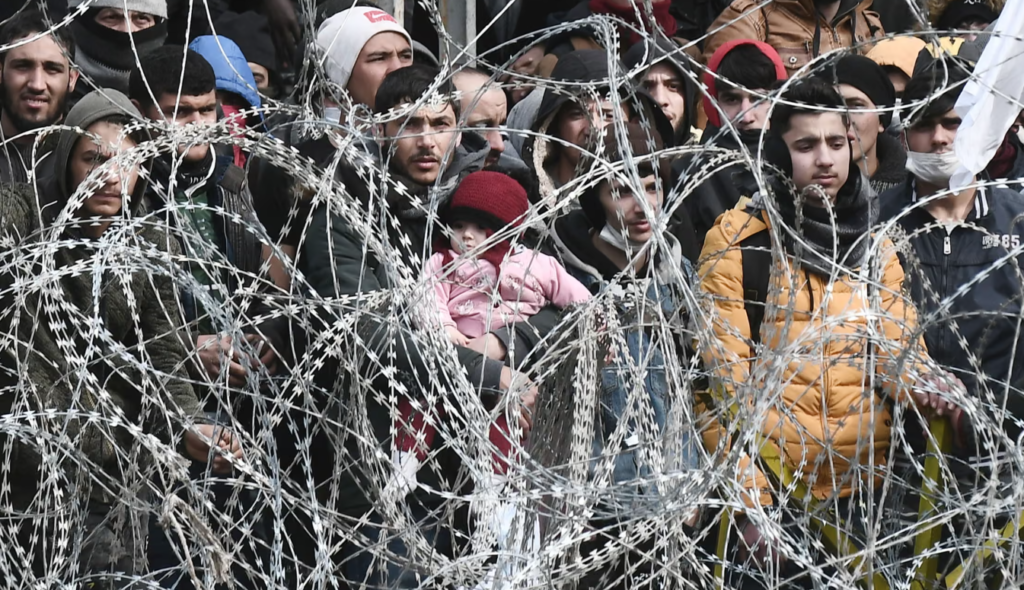
As a result of the Pact’s implementation, there is likely to be an increase in the number of refugees and asylum seekers, including children, being detained for long periods of time in prison-like facilities at the borders of Europe. Member states should in all cases use detention only as a last resort and seek alternatives to incarceration. The detention of children should be prohibited.
DISPERSAL
Under the provisions of the Pact, new arrivals in the EU may be obliged to remain in non-European states that currently lack the resources and infrastructure needed to offer humane and acceptable reception facilities. While there are provisions in the Pact for some arrivals to be dispersed more equitably across the EU, this arrangement will not be binding.
REMOVAL
If recent EU proposals are implemented, people seeking asylum who originate from, or who have passed through, countries that are deemed to be safe, as well as those whose asylum claims have been rejected, will be swiftly removed from member states. If their country of origin or transit refuses to readmit them, they could end up languishing indefinitely in so-called ‘return hubs’ that are likely to involve detention and to be poorly serviced, unless substantial additional resources are devoted to these facilities.
SAFE ROUTES
While the EU has made a commitment to the establishment of regular migration pathways for people wishing to enter Europe and who might otherwise embark on dangerous journeys, the number of people who will be offered access to such safe and legal routes seems likely to be extremely modest.
The EU Resettlement Framework provides a good start, but needs to be significantly more ambitious, commensurate with the EU’s size and its responsibility sharing commitments articulated through the Global Compact on Refugees. States should also explore other schemes such as those linked to education, employment and family reunion, which would significantly increase safe routes for people seeking asylum.
MONITORING
We are concerned that the implementation of the Pact and Strategy will proceed with inadequate and unequal levels of monitoring and accountability across Europe. While the Pact provides for the establishment of an independent border monitoring mechanism, the constraints placed on its capacity may well mean that the abuses committed by states, such as pushbacks at sea and on land, continue unabated.
Civil society organizations (CSOs) have a vital role to play in the monitoring process and are encouraged to engage with national authorities, the media and public so as to ensure that their findings are acted upon. States should facilitate, rather than hinder, the work of CSOs.
To ensure maximum levels of compliance, both with the principles of the EU Pact and with the recommendations of the Manifesto, we also call on national governments and European institutions to monitor the implementation of the Pact in each country and report findings regularly to the EU Asylum Agency, the EU Agency for Fundamental Rights and Frontex. Reports should also be provided to the European and national parliaments.
CONCLUSION
We support a European approach to migration and asylum that enables the region to act in a coordinated, coherent and compassionate manner. In the current political and economic environment, however, those objectives will be difficult to attain. An alternative approach is required, taking full account of the recommendations found in the Manifesto to Stop the Inhumanity at Europe’s Borders.
At the same time, the EU and its member states, with the support of humanitarian and development actors, must take a broader view of the migration and asylum issue, addressing the sources of inhumanity in countries of origin, first asylum and transit. When people move, they should be able to do so out of choice and in safety and dignity.