Having worked for years among refugees, people who fall in the interstices of state protection and need international protection, has led me to think critically about the nation-state, which has become today the sole political system considered as legitimate for organising collective life. The refugee might indeed be the political figure of our times, just as the citizen was during the French Revolution. It is a source of existential anxiety for nation-states, considering that the principle of non-refoulement – so central to international refugee law – represents a limitation of the prevailing doctrine of state sovereignty, constructed on the right to control a territory and its population and therefore to exclude non-nationals.
I had always considered that Jewish diasporic history offered a source of inspiration to imagine transnational forms of political participation. Indeed, the very notion of diaspora invites us to think beyond the normative framework of the nation-state and resist against the ideology of cultural homogeneity. It opens the possibility of transversal connections, through which separate places effectively become linked together by multiple attachments and social ties cutting across national borders. It might be a conceptual alternative to the prevailing model of the nation-state, based on the triad of population-language-territory, which restricts political rights to people supposed to share a cultural identity and dwell in a delimited piece of land. By contrast, Zionism endorses the universalisation of the nation-state as the only entity able to offer protection to people and harmoniously organise social life.
For years, I tried to keep a certain distance from Israel and Palestine. Conducting research on Afghanistan and among Afghans, I felt I already had my load of human suffering. But I could not decline the invitation through Basil Farraj, a former PhD candidate of the Institute who is currently professor at Birzeit University, to participate in the inaugural Ramallah Congress on the Decolonisation of Palestine, jointly conveyed by Progressive International, the Ibrahim Abu-Lughod Institute of International Studies at Birzeit University, and Al-Shabaka: The Palestinian Policy Network. I travelled in the region between the 8th and the 17th of November 2025.
Some twenty delegates – parliamentarians, journalists, lawyers, scholars – from Belgium, Croatia, France, Germany, Ireland, Spain, Switzerland, the United Kingdom, and the United States participated. Crossing the border from Jordan was already an experience that introduced us to the prevailing ambiance. We had been informed of the possibility that our electronic devices might be checked by the Israeli border guards. As a consequence, we were advised to purge our cell phones from anything that could be related to the Congress and remove apps that could be seen with suspicion, such as Signal and Telegram. This set the tone. And indeed, during the whole trip, the omnipresence of the surveillance technology implemented by the Israeli state provoked in me a feeling of unease that I never had before, even in undemocratic places where I travelled, such as Afghanistan, Iran, or Syria.
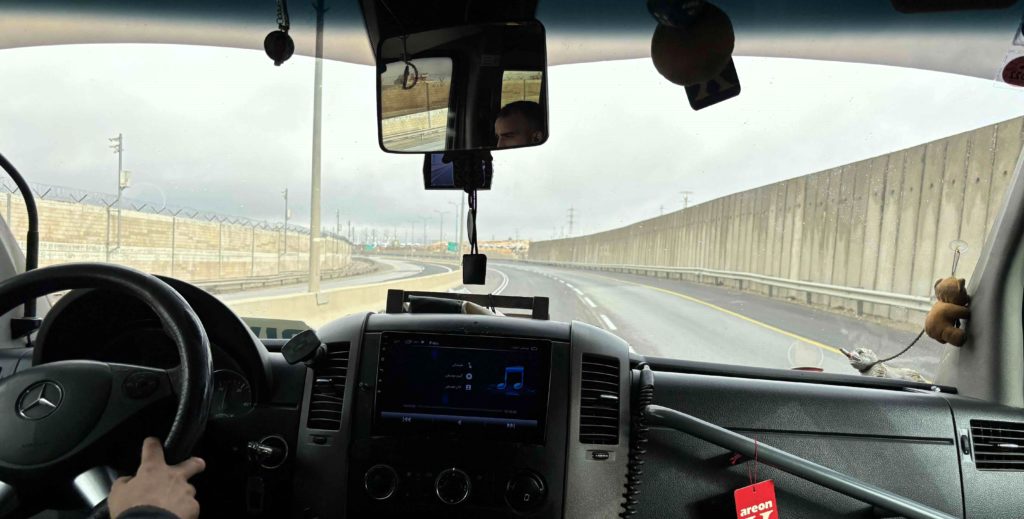
As of the first day in Ramallah, we were able to visualise the political topography of occupation and colonisation. Every hill surrounding the city was occupied by Israeli settlements, which behind high fences looked like military outposts. Like a scar in the landscape, the ugly concrete wall separates local villagers from their agricultural lands. Its security purpose did not appear clearly. Palestinian society is under siege. I was overwhelmed with a sense of asphyxia.
For the following two days, we attended a conference on the campus of Birzeit University. A variety of topics were addressed ranging from settler colonialism, the economic dimension of occupation, the right to education, access to land and agriculture, the role but also the limitation of international law, the principles inspiring the BDS (Boycott, Divestment, Sanctions) movement. Some presentations were more analytical, some others more everday but poignant testimonies of what it means to live and study under occupation. Unlike in Afghanistan, the political administration and humanitarian apparatus were left outside the scope of the discussion by successive speakers. The Palestinian Authority appeared discredited and UNRWA was not considered as very relevant when it came to political solution.
A smaller group of delegates, of which I was a part, extended their stay to travel throughout occupied Palestinian territory. With the Bisan Center, a Palestinian civil society organisation that promotes among other things community development programmes, we had the opportunity to visit the region of Tulkarm, in the north of the West Bank. We met farmers who showed us their vegetable gardens and olive groves. They described the raids conducted by the settlers. These are more and more frequent and violent since 7 October 2023.
Settlers burn trees and poison the land to render it unsuitable for agriculture. The landscape conveys a clear picture of dispossession. This includes multiple check points, yellow and the orange gates that may be closed without prior notice which renders every journey a random venture, the omnipresence of settlements overlooking Palestinian villages. We pass billboards with the inscription “No Future in Palestine” in Arabic, sometimes illustrated by an image of Palestinians being expelled from Gaza. Like the thousands of Israeli flags bordering some roads, it is a campaign by a settler group whose final objective towards Palestinians is all too evident. And indeed, we also had the opportunity to see the refugee camps of Tulkarm and Nur Shams, emptied manu militari from their populations in the summer of 2025. As night fell, they appeared as black holes at the edge of the town.
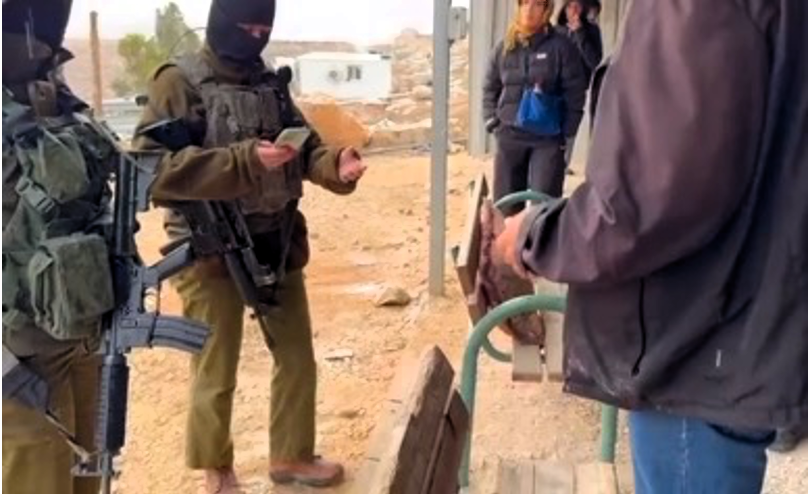
With colleagues from Sabeel, an ecumenical liberation theology center, we toured Jerusalem and Bethlehem. We also went to the Bedouin village of ‘Umm al-Kheir in the South Hebron Hills. Forcedly displaced from the Negev in 1948, these families purchased some land on the southern edges of the West Bank. After all these years, they are now encircled by Israeli settlers, who are becoming more and more aggressive. During our visit, some Israeli vehicles started to circulate around us while filming us through the windows. Eventually, two young women and a man, fully armed, came to indicate that we were in a military zone. After some tense exchanges, another man arrived. He shouted at us, hostilely, that we had 4 minutes to clear off. Like his colleague, his face was covered. He wore a balaclava and sunglasses, but his uniform had no military insignia indicating his Unit. When we left, he followed us on the road for 20 minutes.
I will keep a vivid memory of many encounters, be it with a Jewish peace activist who considers that the humanist legacy of Judaism has to be protected from the Israeli apartheid regime and genocidal action, or with the director of an organic farm saying that Palestinians do not just want peace but want freedom. My trip to a dystopian land, a giant field for testing surveillance technologies and weaponry, was quite traumatizing but also uplifting given the fortitude of those I met. Facts are so crude that they speak for themselves. But I was equally shaken by my return to Switzerland. The complicity of Western authorities is no longer possible to ignore. Peace and justice are not a means to an end but an imperative human right. For Ilan Pappé, the great Israeli historian, the ideological project of the Israeli state is collapsing from within.
Relying on the principle that only people supposed to share a cultural identity and dwell in a delimited piece of land may live harmoniously together, the two-state solution enshrines the prevailing model of the nation-state that I mentioned at the beginning of this brief article.
Can’t the Holy Land be a place where the meaning of living together is reinvented in an inclusive way?
Don’t we all have a responsibility towards Palestinians as well as Israelis?
I am reminded of Omar El Akkad’s recent book: “One day, everyone will have always been against this”. Could this be today?
About the author: Professor Monsutti works at the Department of Anthropology and Sociology, Graduate Institute of International and Development Studies, in Geneva.
The opinions expressed in this blog are those of the author of the presentation and do not necessarily represent the views of United Against Inhumanity (UAI).