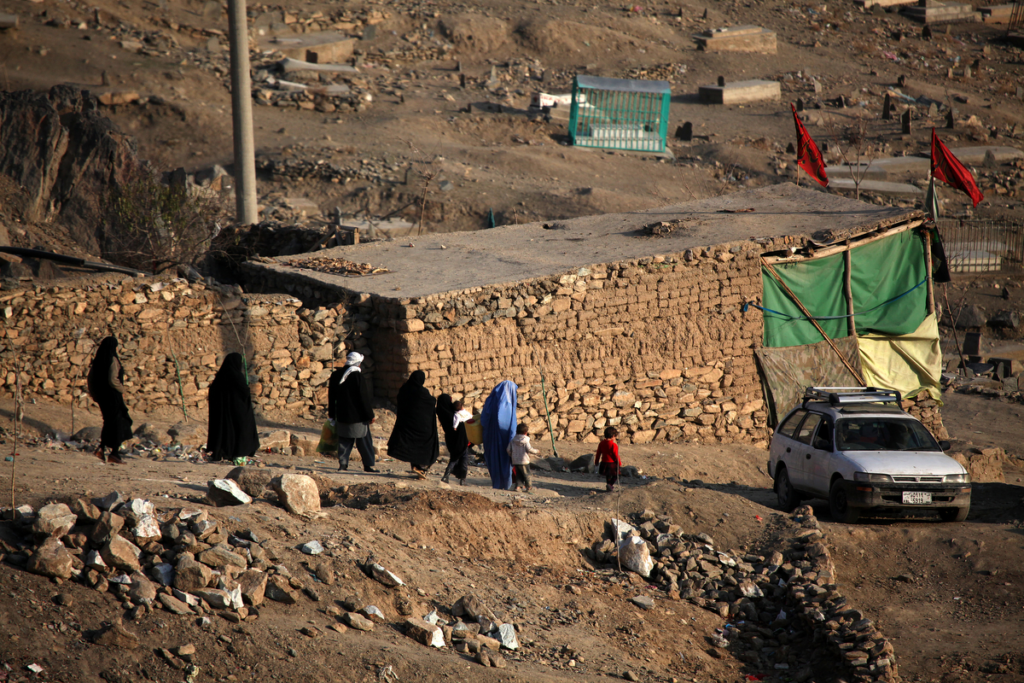
Afghans are caught between Taliban repression and international punitive policies. Both deepen poverty, undermine rights and leave millions paying the price for political decisions beyond their control.
Afghanistan is no stranger to abysmal levels of poverty that have long threatened the survival and life chances of much of its population. This was the case during the post-9/11 years of the US-led war economy, when economic inequality increased even as access to food, education, healthcare and employment improved. Impunity and corruption were rife and greatly benefitted warlords, international contractors and government-linked urban elites.
The return of the Taliban to Kabul in August 2021, upon the withdrawal of US and allied forces, opened a new economic chapter driven by policies that further marginalised impoverished and vulnerable Afghans. International development aid to Afghanistan mostly disappeared. As part of its punitive, post-occupation policy, Washington also abruptly ended its economic support to Kabul that had covered some 75% of government expenditure. In addition, Washington, in collaboration with some European allies, seized some US$9.1billion of Afghanistan’s sovereign external reserves, thereby significantly disabling the country’s central bank, Da Afghanistan Bank (DAB). This greatly restricted the DAB’s ability to maintain a stable exchange rate, a measure that is key to curbing inflation, thereby enabling the poor to purchase basics such as food and fuel for heating and cooking. Blocking access to the DAB’s reserves throttled the economy and banking system, a situation made worse by the overcompliance of external banks that makes international transactions extremely difficult.
The re-emergence of the Islamic Emirate of Afghanistan (IEA) was welcomed by many in-country Afghans as it heralded the end of armed conflict, air strikes, night-time raids and widespread use of improvised explosive devices. However, the IEA soon launched a series of restrictive decrees that greatly subverted the lives of females including their freedom of movement, access to employment and to formal education for girls beyond 12 years. These measures are detrimental to individuals, their families and society in general, notwithstanding various initiatives by civil society and others to reduce their impact. The IEA is infamous for its contempt for fundamental human rights standards and obligations, a stance that has gained it widespread opprobrium and little international support or formal recognition.
The IEA is routinely denounced, albeit to little effect, in the human rights (HR) arena and various fora which tend to prioritise civil and political rights to the detriment of economic rights. The interdependence of gender equality, the right to work and individual economic security is obvious, but it is difficult to understand why formal HR entities routinely ignore the economic warfare and collective punishment resulting from the seizure of Afghanistan’s external reserves. There is widespread awareness of the ramifications of extreme poverty for individuals and groups. However, there has been little effort to advocate for the ending of policies that actually manufacture poverty and undermine the enjoyment of human rights notwithstanding their harmful and deadly consequences.
Human cost of policies antagonistic to human rights and humanitarian values
The drastic reduction in support for humanitarian action geared to helping those who are most at risk has further exacerbated the vulnerability and marginalisation of women and girls. In 2025 the international humanitarian appeal for Afghanistan received only 42% of the $2,4 billion requested. At the time of writing, the 2026 appeal had only received 26% of the smaller, US$1,7bn requested.
This situation is compounded by the millions of Afghans who have been forced to return from Iran and Pakistan in recent years with some 2.5 million expected by the end of 2026. According to a UNDP report “more than 80% of households are in debt while nearly three quarters rely on negative coping strategies to manage getting through the day”; 92% of recent returnees are unable to secure the basic necessities of life. In provinces heavily impacted by returnees “only 3 per cent of people have formal employment, while 78 per cent rely on casual day labour.”
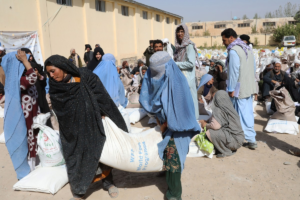
Food insecurity,which had diminished significantly during the first 12 years of the Republic thanks to large scale food aid for hungry families and investment in agriculture, is now dramatically on the rise. In 2026, 3.7 million children under five are at heightened risk of malnutrition, with severe acute malnutrition cases significantly increasing due to food insecurity and inadequate diets. The situation is exacerbated by reduced international food aid, leading to a severe hunger crisis affecting millions.
A combination of fewer female healthpersonnel and reduced support for health care means reduced access to services with, invariably, fatal consequences. The World Health Organization estimated that 521 mothers died for every 100,000 live births in 2023, more than double the global average. The UN Population Fund has warned “that continued disruption to health services could lead to 1,200 additional maternal deaths by 2028.” Meanwhile, the closure of more than 420 health facilities this past year has contributed to a “3 to 4 percent increase in infant mortality” and a noticeable increase in maternal deaths.
Notwithstanding prominent narratives and rhetoric on the difficult situation endured by women in Afghanistan, support for organisations geared to helping such women has also declined significantly. A UN survey of 74 Afghan women’s organisations found that nearly three-quarters experienced funding cuts in 2025. More than half of the organisations surveyed indicated that “they were likely to suspend operations or close entirely within the next year.” Similarly, support that helps women earn a living is also shrinking. In Afghanistan, where female-focused organisations are often the only entities able to reach women on the margins of society, they face mounting difficulties to maintain programmes and outreach given significant aid cuts. UN Women notes that “the weakening of women’s organisations is occurring at a time of massive humanitarian need and growing restrictions on women’s rights.”
Need for Community-based sustainable empowerment
External stakeholders that prosecuted the post 9/11 war and propped up the widely despised Republic era governments, coupled with the IEA’s lack of commitment to inclusive and accountable governance, are greatly responsible for appalling levels of poverty and destitution. The competing agendas of the IEA in Kandahar and those who oppose them have sacrificed the human rights and well-being of Afghans for their own ends. Time is running out for millions of impoverished Afghans but it is not too late to re-think failed agendas and invest in community-based, sustainable empowerment programmes. Investment in small-scale enterprises, including those headed by women and other marginalised groups, should be a priority as well as strengthening basics such as agriculture, irrigation and climate-related risk reduction.
Abandoning the imperial-style seizure of the country’s sovereign reserves could be easily done at no cost to donors. This would enable the DAB, the banking sector and the economy to function in a manner beneficial to all Afghans. Recapitalising the DAB in a monitored fashion is a straight-forward proposition; it would help undo the harm that has been imposed on the people of Afghanistan without any acknowledgement of the human cost involved.
While the IEA remains ostracised by the international community, poverty and deprivation remain chronic. The prospect of international development aid remains bleak despite the reactivation of some limited World Bank and Asian Development Bank projects. More can definitely be done to support local and sustainable development. This could mean direct support to communities as well as small enterprises, including some, that the Taliban seem to tolerate, that are run by women.
In the current geopolitical climate marked by drastic across the board cuts to humanitarian and development aid, more creative approaches are needed. These should focus on local employment and the availability of essential services. In Afghanistan as elsewhere, sustainable development projects at the local level have been shown to yield positive results and break the cycle of dependency on humanitarian aid. The recipes are there but the will to use them is missing. This must change. Meanwhile, by releasing the arbitrarily sequestered Afghan reserves, Western donors would give some meaning to the often-repeated phrase that “Afghan lives matter”.
Other relevant articles published by ISPI in August 2026 on this topic:
Afghanistan, Five Years of Taliban Rule: An Assessment, by Giuliano Battiston
Five years after the Taliban’s return, Afghanistan remains trapped in a cycle of crisis. As the regime consolidates power and gains international recognition, a new approach is needed – one that puts Afghans’ rights, needs and long-term stability at the centre.
https://www.ispionline.it/en/publication/five-years-of-taliban-rule-five-major-trends-243316
The Geopolitics of the Emirate, by Antonio Giustozzi
Five years after their return to power, the Taliban can still boast diplomatic recognition from only one foreign state: Russia. Other countries in the region – primarily China and Iran – have gradually moved closer to diplomatic recognitionbut have stopped short of taking the final step. In their case, reservations certainly do not stem from the segregation of women within the Emirate or a lack of respect for human rights; the issues lie elsewhere – above all, in the conflict with Pakistan.
https://www.ispionline.it/en/publication/the-geopolitics-of-the-emirate-243279
Back to Uncertainty: Afghan Returnees from Iran and Pakistan, by Jelena Bjelica
As Pakistan and Iran expel millions of Afghans, return has become less a durable solution than the start of a new cycle of displacement, poverty and uncertainty in a country ill-equipped to absorb them.
The World’s Worst Women’s Rights Crisis Demands Solidarity and Action, by Shaharzad Akbar
Afghan women face the world’s gravest assault on their rights. As the Taliban institutionalise gender apartheid, governments must prioritise accountability over diplomatic normalisation.
“The Taliban Continue to Entrench Their System” – Interview with Richard Bennett by Giuliano Battiston
https://www.ispionline.it/en/publication/the-taliban-continue-to-entrench-their-system-243280
The EU and the Taliban: Deportations Prioritised Over Human Rights, by Thomas Ruttiq
Behind the language of ‘technical engagement’, the EU is expanding cooperation with the Taliban to enable deportations – testing the credibility of its human rights commitments.