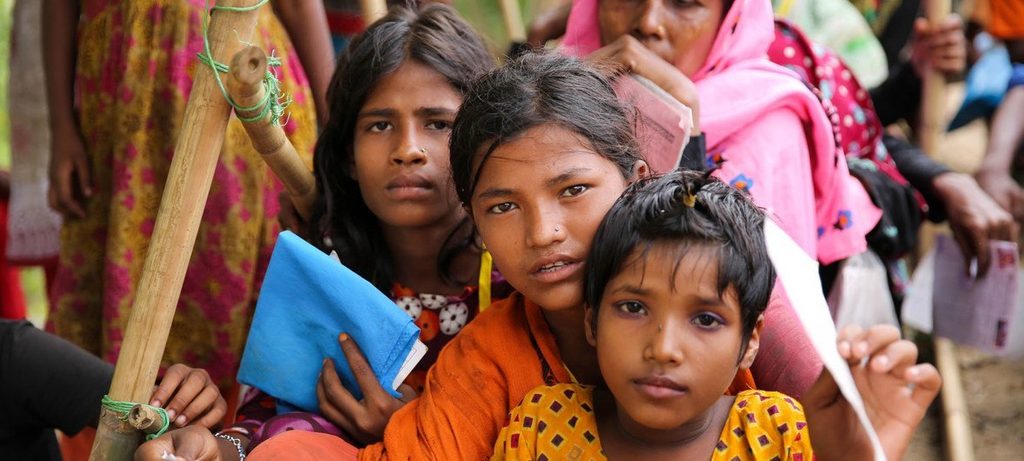
Stateless and displaced
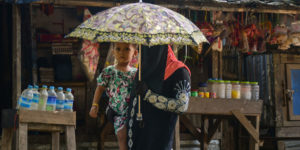
The Rohingya are a primarily Muslim minority group, whose citizenship is not recognized by Myanmar, their country of origin. More than a million Rohingya remain stateless today, scattered across refugee camps in Bangladesh, displacement sites within Myanmar, and informal settlements across South and Southeast Asia.
Within this crisis, another deeply troubling trend has emerged: the trafficking of Rohingya women and girls.
The true scale of trafficking is difficult to determine, as much goes unreported. Bangladesh’s interagency Anti-Trafficking Working Group identified, referred, and assisted 316 trafficking victims in Cox’s Bazar in 2024 alone, though it cautions that these figures do not reflect the extent or prevalence of trafficking in the camps.
As the Rohingya remain stateless, their vulnerability to trafficking, exploitation, and gender-based violence continues to grow. Deprived of legal protection, they are frequently treated as illegal migrants rather than refugees entitled to humanitarian protection, encountering further persecution through criminalisation and detention.
Vulnerability to trafficking
Having fled genocidal violence in Myanmar, more than one million Rohingya refugees now live in overcrowded camps and settlements across Bangladesh, most notably in the area of Cox’s Bazar. The arrival of more than 700,000 refugees in 2017 placed enormous pressure on already-overcrowded camps, and severe restrictions on employment, limited educational opportunities, and chronic poverty have left many Rohingya families with few viable means of supporting themselves.
With opportunities inside the camps becoming increasingly scarce, many Rohingya are driven to seek livelihoods and security beyond their boundaries despite the significant risks involved. This combination of desperation and restricted mobility creates fertile ground for traffickers to exploit vulnerable women and girls.
According to the Kaladan Press Network, many Rohingya women and girls are deceived by promises of employment, marriage, or safe passage to countries such as Malaysia and Thailand. Once separated from their families, many are forced into sexual exploitation, domestic servitude, or other coercive arrangements.
Women and girls who remain inside the camps are also vulnerable, with traffickers exploiting their economic insecurity and limited opportunities to recruit them into gendered forms of exploitation. This is not incidental: UN experts estimate that approximately one in four women and girls in the camps have experienced gender-based violence, underscoring that trafficking here cannot be separated from gender itself.
Survivors of sexual exploitation often face profound social stigma, discouraging many from reporting abuse or seeking support. Fear of shame, ostracism, and retribution leaves many victims trapped in cycles of exploitation.
Their vulnerability is further compounded by statelessness: without citizenship or legal recognition, many Rohingya women and girls are unable to access meaningful protection or justice, and because states treat undocumented movement as an immigration enforcement issue, many become reluctant to approach the authorities, leaving them at greater risk of trafficking and exploitation.
Trafficking networks
Trafficking networks target Rohingya women and girls by exploiting the desperation and legal precarity described above. Drawing on interviews with survivors, the Kaladan Press Network’s 2023 report maps out how this unfolds, from the initial deception through to the journey itself.
Women and girls fleeing violence and deprivation are frequently lured by offers of employment or marriage to men in other countries, while those seeking an income may be promised work in domestic labour or factories. In some documented cases, traffickers have adapted their methods by using women as recruiters to build trust and persuade Rohingya girls that offers of employment are genuine.
However, once an offer is accepted, individuals become trapped, forced into gendered labour such as prostitution or domestic servitude, and are not paid the agreed amount, if at all. This practice explains why women and girls account for two-thirds of those who have received support from the IOM in Cox’s Bazar after escaping or being rescued from exploitation.
Financially desperate families arrange marriages for their daughters to Rohingya men already living in third countries, driven by high demand for brides among predominantly male Rohingya migrant communities and their families’ inability to afford local dowry payments. What is framed as a marriage arrangement frequently becomes indistinguishable from a sale, with young girls facing forced marriage once they arrive.
Once a family agrees to send a daughter, the journey itself is organised through a network of brokers operating inside the camps. The overland route to Malaysia alone costs thousands of dollars, paid upfront or in instalments across the journey.
Brokers and smugglers have been documented holding people hostage mid-transit, demanding additional payment beyond what families already agreed, with those unable to pay left stranded, abandoned, or worse.
According to the Kaladan Press Network’s report, those being smuggled are almost entirely women and girls, with only one or two men travelling among them, while the smugglers escorting them are always men. This profound imbalance leaves women and girls travelling in a group with virtually no protection, and under the near-total control of outsider men for the remainder of the journey.
Violence and abuse
For many Rohingya women and girls, what begins as a search for safety or opportunity quickly turns into prolonged exploitation and violence at the hands of traffickers, defined by its deeply gendered and sexual nature.
Survivors who escaped trafficking recount consistent patterns of physical abuse throughout their journeys. Many describe being deprived of food and water, concealed in dangerous conditions during transit, and subjected to beatings and shootings by smugglers and traffickers.
Sexual violence is equally pervasive. In one case documented by the Kaladan Press Network, a group of Rohingya women were abducted at the beginning of their journey, detained, and repeatedly sexually assaulted by smugglers while their relatives were extorted for money in exchange for their release. Other survivors described being isolated under the pretence of contacting their families before being raped in remote forest areas. Women who resisted sexual violence were beaten, tortured, or threatened with death.
For women and girls trafficked into commercial sexual exploitation, the abuse is often prolonged and systematic. Many are forced into the sex trade across countries such as Bangladesh and India, where demand for young Rohingya women and girls sustains a lucrative market for abuse.
The abuse is not limited to paying clients. Traffickers themselves frequently participate in the sexual exploitation of the women and girls under their control. In an investigation by PBS NewsHour, one trafficker admitted that he raped victims before forcing them into commercial sex work, describing how he had sex with all the girls to “take their virginity” before they were sold to clients. His account illustrates that sexual violence and control are part of the traffickers’ exploitation, alongside financial gain.
A BBC investigation into the cross-border sex trade repeatedly found that Rohingya girls were regarded as the least desirable and “cheapest” victims available in the market. This reflects a disturbing reality about statelessness: rather than being recognised as a failure of the state, its consequences become personalised, attaching themselves to an individual’s perceived worth and dignity. In an industry built on the commodification of human beings, Rohingya women and girls are further devalued because of this stigma.
Criminalisation
For many Rohingya women and girls, escaping their traffickers does not guarantee freedom. Instead, they face a new ordeal with the state, characterised by criminalisation, detention and institutional failures.
When trafficked Rohingya women and girls are encountered by authorities, whether in Bangladesh, India, Myanmar or Thailand, they are often treated as immigration offenders instead of victims of trafficking. Instead of receiving legal protection and victim-centred aid, many are sent to detention facilities where the cycle of abuse continues.
In Bangladesh, Rohingya women and girls caught by authorities are arrested and subjected to immigration enforcement. They may be detained for months until they pay a fee before being processed through a National Referral Mechanism upon release. In most cases, rescued women and girls are returned to Cox’s Bazar, to the same environment of extreme poverty and restricted movement that initially left them vulnerable to traffickers.
Rohingya women and girls arrested in India have reported treatment in prison that closely resembled the abuse inflicted by traffickers. One woman recounted being beaten so severely that she miscarried.
In Myanmar, the relationship between trafficking networks and the state is much less passive. Interviewees in the Kaladan Press report described traffickers paying authorities, including the Arakan Army, to pass through checkpoints. In one case, the Myanmar navy allowed an intercepted group to continue after smugglers made a payment.
Those later arrested by the authorities reported being beaten and sexually abused before being detained for illegal travel. Adults were generally sentenced to two years in prison, while minors could spend up to one year in juvenile correction facilities; by contrast, prosecuted smugglers received sentences of 16 years. Whilst in jail, Rohingya received no protection from discrimination by other prisoners, including physical abuse or insults such as “kalaa”, meaning foreigner in Burmese.
The victimisation of Rohingya women and girls extends beyond criminalisation and detention. In some cases, state officials have moved beyond failing to protect victims to actively facilitating trafficking in collaboration with criminal syndicates.
Although the identities of those leading many trafficking networks remain largely unknown, investigations have exposed the involvement of state officials. Thai prosecutors, for example, traced more than US$1 million in bank transfers from a trafficking network to a Thai lieutenant general. The investigation ultimately led to the conviction of 62 individuals, including senior government and military officials.
Trafficking networks have also exploited fraudulent documentation to move Rohingya women and girls across borders. According to a Bangladeshi investigator quoted by The Business Standard, traffickers forged passports and national identity cards through several offices in Dhaka, with passport and election officials allegedly involved in the scheme. Once provided with these false identities, trafficked women and girls become absorbed into the system and significantly harder to rescue.
India’s BJP government has characterised the Rohingya as illegal immigrants and a threat to internal security. According to the UN Human Rights Office, at least 40 Rohingya refugees detained in New Delhi were cast into the sea by the Indian Navy near the maritime border with Myanmar and forced to swim for their lives, with their subsequent whereabouts in Myanmar remaining unknown. The Supreme Court later declined to hear a legal challenge against these alleged “illegal deportations”.
Similarly, in 2022, Thai police rescued 59 Rohingya, including children, after they were abandoned by smugglers near the Malaysian border — yet despite receiving humanitarian assistance, they were still detained and prosecuted for illegal entry.
While states have legitimate interests in managing their borders, placing responsibility on trafficked Rohingya women and girls rather than on the highly organised criminal syndicates that exploit them—and the political conditions that force them into irregular migration—risks depoliticising a crisis rooted in statelessness and the systematic denial of rights.
This challenge is compounded by ASEAN’s principle of non-interference, which has constrained regional efforts to address the underlying drivers of trafficking and strengthen human rights protections.
Survivor testimony suggests that the greatest fear during these journeys was not only abuse by traffickers but also apprehension by authorities. Criminalisation and lack of legal status deter many victims from seeking assistance, allowing trafficking networks to operate with relative impunity. Many Rohingya women and girls are aware of the risks they are taking, but will continue to be trafficked because of the dire situation in which they find themselves.
About the Author: Sumayya Ferdous is a researcher interested in humanitarian affairs, human rights and forced displacement. Her work explores the challenges facing displaced populations and the political and institutional factors shaping humanitarian protection.
The opinions expressed in this blog are those of the author of the presentation and do not necessarily represent the views of United Against Inhumanity (UAI).