The Rohingya are a stateless Muslim minority group from Myanmar who have been subjected to decades of repression and expulsion. While the plight of those living in countries such as Bangladesh, India and Malaysia has been well documented, much less is known about those who reside in Saudi Arabia. This blog analyses the limited evidence available.
Introduction
For many years, members of Myanmar’s Rohingya population have travelled to Saudi Arabia seeking economic opportunity and refuge from persecution. But these goals have proven to be increasingly elusive.
Restrictions on movement and residency have intensified, increasing the Rohingya’s exposure to exploitation and deepening the precarity of daily life. Lacking legal protection and stable pathways to regularization, they face growing uncertainty, including, for some, the prospect of detention and deportation.
These developments reveal a broader pattern in which official ambiguity derives not from an administrative oversight but as a central feature and failure of governance for the Rohingya in Saudi Arabia.
Saudi Arabia’s Rohingya population
The Rohingya presence in Saudi Arabia dates back to the 1950s, when small numbers travelled by land and sea to Mecca to perform Hajj. Larger waves followed in the early 1970s after violence perpetrated against them in Myanmar. In 1973, King Faisal granted residency to Rohingya fleeing persecution, allowing them to work, live and travel within the Kingdom.
Many settled in under-served neighbourhoods of Mecca and Medina, forming close-knit networks that expanded over time as established families helped relatives to obtain visas through Saudi sponsors. Most work in low-paying roles such as street vending, cleaning, portering and other forms of unskilled labour, with the more fortunate amongst them becoming drivers.
For many, these arrangements initially appeared to offer a pathway to stability. Generations born in the Kingdom were able to maintain residency, a status that was often perceived as a type of informal citizenship. These arrangements, however, relied on administrative discretion rather than legal guarantees.
In terms of numbers, estimates vary widely. Several suggest that between 400,000 and 500,000 Rohingya are resident in the Kingdom, while the 2022 Saudi census recorded 163,700 people originating from Myanmar. In 2017, the authorities reported issuing approximately 250,000 special residency permits to Rohingya.
These divergent numbers reflect the wider challenge of Rohingya recognition and representation in Saudi Arabia. The absence of consistent registration mechanisms, combined with ambiguous legal status, contributes to persistent uncertainty over the size and visibility of the population.
Saudi refugee governance
Saudi Arabia is one of 44 states that are not signatories to the 1951 UN Refugee Convention. It has no domestic legal framework for the recognition or protection of refugees. As Maja Janmyr and Charlotte Lysa note, the Saudi approach is best described as ad hoc, including the provision of temporary residency permits, limited access to basic services such as health and education, and short-term integration in the labour market.
In that respect, Saudi policy is closely tied to the kafala or sponsorship system. This framework reinforces the temporary nature of migration and shifts administrative responsibility onto employers, who exercise significant control over foreign workers.
Thus, in 2005, the Saudi Interior Minister stated that the Rohingya were “Burmese Muslims” who had come to perform Hajj but could not return, granting them residency and permission to work. Employers were encouraged to recruit from the Rohingya community, an arrangement later formalised by a Ministry of Labour policy that allowed employers to hire four times as many Rohingya as other foreign workers.
In 2013, the government established a committee to regulate the residency status of the Rohingya, but the resulting framework applied only to those who had arrived before 2008. Subsequent policy amendments expanded the authority of employers under the kafala system, enabling the Rohingya to be detained and deported if they attempted to work for anyone other than their officially recognised sponsor. As a result, some had no choice but to surrender their passports to their employers and to work under exploitative conditions.
Saudi Arabia has a distinct vocabulary in relation to the Rohingya and other refugees, referring to them not as such but as “guests,” “visitors,” or “brothers,” drawing on the language of Islamic hospitality and solidarity. This narrative serves several functions. It presents Saudi Arabia as a generous host, implies that the Rohingya displaced are receiving a favour rather than exercising rights, reinforces the expectation that all refugees are temporary regardless of how long they have lived in the Kingdom, and obscures the state’s legal responsibilities toward those in need of international protection.
Rights and citizenship
When the Rohingya first arrived in Saudi Arabia in the 1950s, Bangladesh was part of Pakistan, many believed that long-term residency would lead to some form of regularised status or even citizenship. According to one Pakistani embassy official interviewed in 2012, this expectation contributed to the country’s decision to stop renewing passports for Rohingya who had historically been documented as Pakistani nationals.
The absence of a secure nationality has left many Rohingya families in an increasingly precarious position. Under Saudi nationality law, children born to Rohingya fathers and Saudi mothers are not automatically eligible for citizenship, reinforcing patterns of inherited statelessness across generations.
Regional dynamics also play a role. Bangladesh, whose large migrant workforce in Saudi Arabia depends on the kafala system, has limited leverage to reject Rohingya deportations. Saudi authorities have reportedly used this labour dependency in negotiations over accepting deported Rohingya, underscoring how migration governance intersects with statelessness and economic interdependence.
Saudi Arabia’s ad-hoc approach has left many Rohingya in a condition of ‘permanent temporariness’, with longstanding residents unsure of whether and to what extent any of the rights and permissions they hold today will still apply tomorrow.
In March 2017, the Saudi Interior Ministry launched the ‘Homeland without illegals’ campaign, part of a wider effort to curb irregular migration and enforce residency rules. Since then, the authorities have carried out extensive raids to identify, detain and deport individuals deemed to lack valid documentation.
Detention and deportation
Many of these operations have occurred in Rohingya-populated neighbourhoods of Mecca, with reports of officers conducting raids while dressed as local residents. Businesses in these areas have also been targeted, while identity checks at roadside checkpoints have become more frequent. These practices have generated heightened uncertainty, prompting many Rohingya to rely on encrypted messaging apps to communicate with each other and to avoid digital surveillance.
Tensions have been heightened by clashes involving different migrant communities, private citizens and the security forces, with some reports suggesting that such incidents have been exacerbated by an inadequate police response.
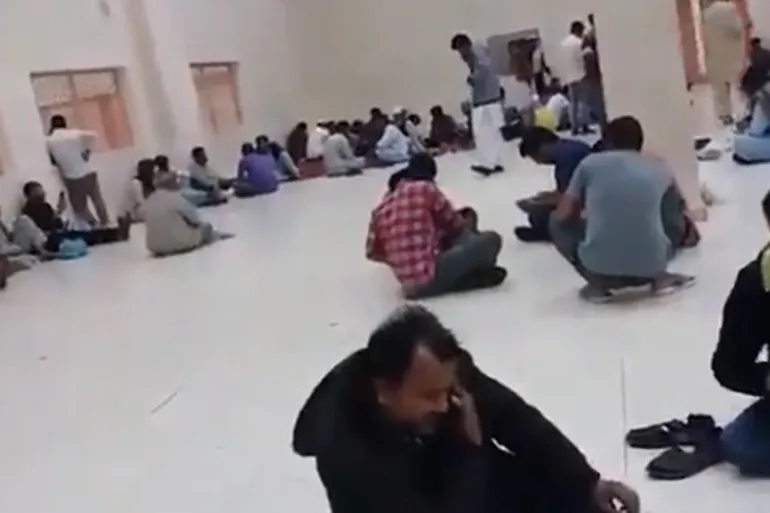
Those detained during police operations are typically transferred to large detention centres, the most prominent being the Shumaisi facility near the Jeddah–Mecca highway. The complex reportedly holds up to 32,000 people and spans more than 2.5 million square metres, with men detained separately from women and children.
Upon arrival, detainees have their belongings, including passports and documents, confiscated. Many report receiving little information about their cases or the duration of detention, with some held for several years.
Concerns about the treatment of detainees in Shumaisi have been raised for more than a decade. A 2015 Human Rights Watch report documented inadequate food and sanitation and instances of violence by guards. Videos circulated by detainees show Rohingya prisoners engaging in a hunger strike. During one 2019 protest, seven out of roughly 650 Rohingya detainees were hospitalised. Other accounts describe immigration officers threatening to withhold water, blankets and clothing.
For many detainees, the primary motivation for protest is the desire to be released so they can resume work and support families abroad. Yet the statelessness of the Rohingya severely limits their options. Appeals to the consulates of India, Nepal and Pakistan are routinely rejected. Bangladeshi diplomats sometimes facilitate exit in exchange for a reported fee of $500 to $700, while other detainees resort to informal payments in the hope of securing their release.
Prolonged confinement contributes to significant psychological distress. A report by Middle East Eye highlights the anxiety produced by unclear legal procedures and uncertainty over release, with detainees describing a persistent sense of insecurity about their future.
Upon release, individuals undergo biometric registration, including fingerprint and retinal scans, which are added to a national database that bars undocumented workers from re-entering the Kingdom. While release provides relief for some, others face long-term consequences, including loss of livelihood and separation from community networks established over decades.
Despite the conditions reported by detainees, the official discourse portrays those held in Shumaisi as violators of immigration and residency laws. The official Saudi Gazette has also described the facility as a well-resourced centre providing food, healthcare and administrative support to those awaiting deportation.
Deportations are publicly framed as “repatriations” to countries such as Myanmar, Bangladesh and Pakistan. For many Rohingya, however, these states do not represent places of origin or citizenship, raising further concerns about their rights. Saudi government statements also emphasise the financial cost of deportation, reinforcing a narrative in which enforcement is presented as both necessary and burdensome.
The role of UNHCR
Saudi Arabia is not a signatory to the 1951 UN Refugee Convention and has no formal procedure for the recognition of refugee status. UNHCR works in a restrictive environment and in close cooperation with Saudi authorities, limiting its ability to intervene on behalf of people falling under its mandate.
These constraints are reflected in the organisation’s public documents. Its 2024 factsheet on Saudi Arabia, for example, portrays the country as a “longtime partner” and emphasises the Kingdom’s contributions to humanitarian and development programmes. The Rohingya in Saudi Arabia are, the factsheet reports, treated “generally tolerant.”
This diplomatic language is typical of UNHCR’s engagement in non-signatory contexts, where the organisation’s activities depend heavily on maintaining constructive relations with the state.
As Lysa notes, UNHCR’s role in Saudi Arabia consists primarily of advocacy and monitoring. Its ability to register or provide direct assistance to refugees is limited, as is its access to people who are detained or at risk of deportation. These considerations all reinforce the ambiguous status of the country’s Rohingya refugees.
Conclusion
The absence of formal refugee recognition and rights in Saudi Arabia is not merely an administrative oversight, nor is it a refusal to adopt legal frameworks associated with Western legal traditions. It forms part of a governance model that allows the state to have a wide degree of discretionary authority over the Rohingya and other residents who are not Saudi citizens.
To enhance their protection, the Rohingya in Saudi Arabia should be formally recognised as refugees by the country’s authorities, rather than being broadly categorised as ‘Burmese’ or as ‘Muslim migrants from Myanmar’. Such formal recognition would improve the ability of the Rohingya to exercise rights and access services, while reducing the risk of them being subjected to punitive treatment.
Legal recognition as refugees should be accompanied by mechanisms that protect Rohingya from employer abuse, passport confiscation and arbitrary loss of residency. Establishing clearer pathways to regularisation would reduce the ‘permanent temporariness’ that currently characterises their situation. On no account should members of Saudi Arabia’s Rohingya population be deported to Myanmar.
While recognising the constraints under which UNHCR has to work, the organisation should advocate with the Saudi authorities on behalf of the Rohingya, speaking out in public when necessary to challenge the country’s policy of strategic ambiguity. In accordance with the global commitments it has made in relation to refugee consultation and representation, UNHCR should support the establishment of Rohingya-led organisations, ensuring that their perspectives and protection priorities are brought to the attention of the authorities.
About the Author: Sumayya Ferdous is a humanitarian practitioner and researcher specialising in Rohingya refugee protection and displacement issues. Her work focuses on gender, child protection, and advocacy for the rights and wellbeing of displaced communities.
The opinions expressed in this blog are those of the author of the presentation and do not necessarily represent the views of United Against Inhumanity (UAI).