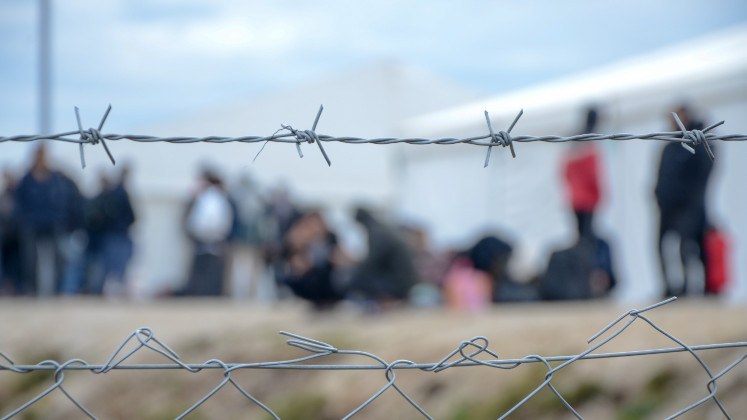
This keynote explores how detention, deportation systems, and undocumented status generate forms of legal precarity that profoundly shape psychosocial wellbeing. It connects border regimes and immigration policy to lived experiences of uncertainty, stigma, and suspended belonging. Moving beyond narrow individualised framings, the talk situates distress within the structural and relational conditions that produce it. It argues that humane and effective responses to forced migration must address legal architecture and public narrative alongside care and support.
When we witness the suffering of people labelled as asylum seekers, refugees, and undocumented people, our immediate societal impulse is often to reach for the vocabulary of Western psychology. We speak of “trauma”, stress, and resilience. We look at individuals and try to diagnose their pain.
But what if the frameworks we use to understand this distress are narrowing our vision?
Mainstream Western psychology and psychiatry operate on a straightforward, almost mechanistic logic: if you want to understand a person, you break them down into constituent parts (their thoughts, emotions, behaviours, symptoms, and diagnoses). The assumption is that if you treat the individual parts, you heal the person. However, this clinical vocabulary is far from a neutral or universal truth. It emerged from highly specific Euro-American traditions. While it can be useful in certain clinical contexts, it carries a distinct danger when applied to forced migration: it locates the pathology entirely within the person’s interiority. By focusing solely on the individual’s mind as the site of dysfunction, we effectively sanitise and obscure the hostile social, legal, and political conditions that actively produce and sustain that suffering.
The Performance of “Trauma”
In the context of the global border regime, this clinical over-coding takes on a deeply bureaucratic, almost violent significance. People who were forced to migrate find themselves navigating legal, humanitarian, and clinical systems that demand their lived experiences be rendered legible to Western metrics of trauma.
To secure safety or legal status, individuals are required to narrate their deepest histories of displacement in ways that are linear, coherent, and recognisable to the state (which includes within specific linguistic registers). Within these administrative spaces, fear is transformed into a form of currency; suffering becomes an objectified asset that must be repeatedly displayed, performed, and verified.
This system traps people within rigid, dehumanising dichotomies. They are forced to occupy the script of either the passive, completely shattered victim or, conversely, the hyper-resilient, idealised hero. This reductive casting privileges easily pathologised, discrete expressions of distress (such as the neat criteria of Post-Traumatic Stress Disorder (PTSD)) while utterly delegitimising the more pervasive, insidious forms of suffering that define daily life at the border.
Legal Precarity as a Living Environment
We often talk about “legal precarity” as if it were a neutral administrative category or a temporary state of limbo. Precarity functions as a totalising psychological, somatic, and relational environment. To live indefinitely without knowing whether you will be permitted to stay, work, settle, form safe relationships, or imagine a future is to be cast into a chronic state of suspended belonging. This suspension fundamentally fractures a person’s phenomenological relationship with time, turning the future from a horizon of hope into an unpredictable source of dread. It erodes the capacity to trust and estranges one’s relationship to community. When we look closely at this environment, we see that acute psychological distress is not merely a psychological artifact carried forward from past experiences of conflict or persecution. It is being actively, dynamically manufactured in the present moment by the structural violence of systems that deliberately keep people in prolonged states of state-enforced uncertainty and hyper-conditionality.
The border is not just a geographical boundary; it is a moving psychological apparatus that replicates itself within the very bodies and minds of everyone, especially those forced to navigate it in this alienating way.
The Risk of Therapeutic Containment
This poses a profound ethical challenge for those of us in the helping professions. Practitioners, therapists, and humanitarian workers offer vital spaces of human connection and relief. But we must ask an uncomfortable question: what are the limits of our interventions when they take place within systems that continue to systematically inflict harm?
If care and psychosocial support are offered in a vacuum (entirely divorced from an explicit commitment to rights and structural justice) there is a distinct risk that our work degenerates into a tool of containment. Instead of acting as a site of healing, the therapeutic space can inadvertently become a mechanism that helps marginalised people adjust to, tolerate, and endure hostile state architectures that remain fundamentally inhumane. Care without a critique of power subtly shifts the burden of adaptation onto the shoulders of the oppressed, leaving the oppressive system entirely unchallenged.
Shifting the Paradigm Toward Justice
If we are to respond meaningfully to the psychosocial impact of forced migration, we must radically expand our understanding of what wellbeing is.
Well-being is not a product of individual coping mechanisms, cognitive restructuring, resilience or privatised clinical treatment. It is co-constituted by material and social realities: unrestricted access to safety, legal protection, collective community, meaningful activity, equity and belonging, and the concrete viability of a future.
Humane responses to forced migration must therefore move resolutely beyond individualised compassion or paternalistic charity. We must step away from the narrow question of how best to support individuals who are suffering, and instead ask the more urgent, uncomfortable question: what structural changes are we willing to fight for to dismantle the very systems that manufacture that suffering in the first place?
This publication is an excerpt from Dr Claire Marshall’s keynote address delivered at the launch of the United Against Inhumanity Manifesto at the University of East London on 16 April 2026.
About the author: she is a senior lecturer and chartered counselling psychologist in the university’s School of Childhood and Social Care. Her work focuses on areas such as refugee and forced-migration mental health, psychosocial interventions, trauma, humanitarian operations, and critical psychology. She has worked as a clinician, researcher, academic, and consultant with organizations including projects linked to international humanitarian and policy initiatives.