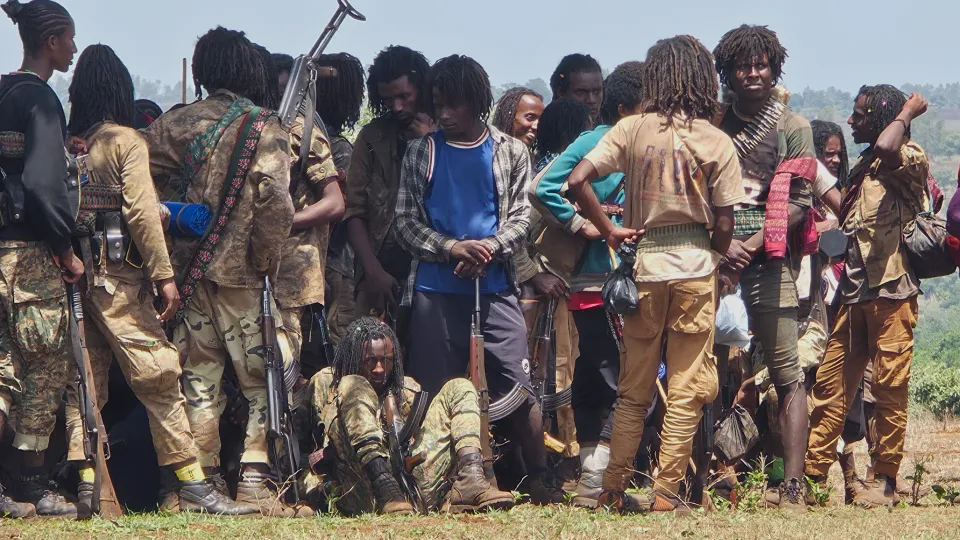
Five years after the signing of the Cessation of Hostilities Agreement (COHA), officially known as the Pretoria Agreement, between the government of Ethiopia and the Tigray People’s Liberation Front (TPLF), Ethiopia faces another round of conflict with wider political and humanitarian implications. On Sunday, October 4th, Ethiopian National Defense Force troops recaptured Mekelle after it had been taken over by TPLF forces. These developments come as communities in Tigray are dealing with a severe El Niño–driven drought while still recovering from the war that ended in 2022.
On September 20th, six armed factions from the Amhara, Afar, Oromo, Benishangul-Gumuz and Somali regions joined the TPLF to announce the formation of the ‘Ethiopian Alliance for Survival’, with the objective of overthrowing the government in Addis Ababa. There is speculation about the alliance’s prospects: whether the combined forces will be strong enough to unseat the government, and whether they offer a real, coherent policy to tackle the many issues facing Ethiopia.
These events are also occurring during a global climatic event that is affecting livelihoods and food security in the Horn and in many other regions of the world.
Aid Reduction Impact in Ethiopia
In January 2025, the international development and humanitarian community was rocked by an earthquake emanating from Washington, DC: the sudden and abrupt cutting of all US aid programs and the start of the process of dismantling USAID.
USAID, with an annual budget of over $40 billion, had been supporting millions of people across the globe. Nowhere was this truer than in Ethiopia, long its second-largest recipient: between 2020 and 2023, for example, humanitarian spending in Ethiopia exceeded $3.8 billion.
The cuts have had a severe impact, resulting in program reductions, staff redundancies and terminated vendor contracts. The hardest-hit sectors have been health, education, water and agriculture, along with the very important Famine Early Warning Systems Network (FEWS NET). Despite the cost to organizations, Ethiopia still has a large community of national NGOs, with 368 currently registered under the Consortium of Christian Relief and Development Associations (CCRDA). It also has its own national Red Cross society, one of the oldest in Africa. All of them continue, to the best of their ability, to work at local and regional level alongside international agencies, and they can reach communities in need.
Still, Ethiopia has long hosted a large UN and NGO presence, and it now has to adapt to these changes in the middle of ongoing conflict and refugee influxes from the crises in Sudan, South Sudan and Somalia. This is bound to cause additional strain and to weaken capacity to prepare for and respond to sudden new displacement and to crises affecting health, water, food security and livelihoods.
There is also the memory of strained relations with the government during the last conflict (2020–2022), when UN agency staff were expelled.
Ethiopia’s new national disaster policy on emergency assessments, targeting and relief provision asserts control over data collection and distribution, as part of major commitments to self-reliance and “statistical and humanitarian sovereignty”.
These measures could allow penalties for public discussion of aid and for sharing false information about it, which could affect national and international agencies alike.
For two years running there has been no Humanitarian Appeal Process. The country was also excluded from the 2026 Global Report on Food Crises because of disagreements over estimates of beneficiaries and internally displaced people, and because of restricted access to the crisis-affected areas.
Violence, Modern and Conventional
Warfare in Ethiopia is itself changing, with both government and opposition forces using drones. The Ethiopian government has invested heavily in its own capacity to manufacture different kinds of weapons and in improving its technical capacity in drone technology.
Drones helped stall the 2020 conflict with Tigray and have been used ever since in several parts of the country to target militias, often harming civilians and civilian structures. In a surprising development, there have been reports of sporadic drone attacks in Addis Ababa.
At the same time, conventional ground fighting has killed and displaced thousands. Traditionally, forces have occupied towns by first shelling them heavily and dispersing their populations. The 2020–2022 war with Tigray, which killed over 600,000 people, was notable for its viciousness, vengefulness, human rights violations and weaponized sexual violence. Blockades of humanitarian assistance, the targeting of civilians and humanitarian staff, and the looting of schools, hospitals, warehouses and other infrastructure caused a breakdown of basic services and inflicted extreme suffering and displacement on civilians.
The resumption of fighting today raises the specter of renewed atrocities and protection concerns.
An already militarized society will become further militarized through more recruitment and conscription of young people and the creation of new civilian militias to fight the opposition.
Regional Implications
All this is happening in a regional and global context of accelerating volatility that threatens to spread and engulf neighboring countries in the Horn.
Tensions between Ethiopia and Egypt over the Nile are ongoing, and Ethiopia also accuses Egypt of thwarting its attempts to gain access to the Red Sea and the port of Assab. Relations with Sudan have been complicated: Tigrayan rebels have been accused of receiving support from the Sudanese Armed Forces in Khartoum. In response, the Ethiopian government has allowed the Sudanese anti-government Rapid Support Forces to operate inside Ethiopia’s borders. The government perceives that Egypt and Eritrea have now joined forces with the internal Alliance for Survival, and that together they pose an existential threat to the nation. Further complications arise from the US–Iran war and the Houthis’ recent moves to control access and transport along the entire Red Sea coastline.
Conclusion: Urgent Action on Protection and Assistance
The international community cannot stand by and allow internal and external actors to push Ethiopia and the region further into chaos, destruction and potential famine. There must be a concerted effort to stop the fighting. In all mediations, the warring parties must commit to allowing immediate humanitarian access, and resources must be accelerated to maintain emergency logistics and pipelines.
- The monitoring mechanism established by the African Union must be reconvened and made operational in the country, to ensure neutral, accountable monitoring and public reporting on conditions in the conflict area and on citizens’ access to aid.
- The UN Office of the High Commissioner for Human Rights should closely monitor the situation in Ethiopia, release regular public reports and brief the UN Human Rights Council.
- The Ethiopian Human Rights Commission must also be allowed access to all areas.
- The Ethiopian government must ensure that civil society organizations working with survivor communities have immediate access to provide physical and mental health support to victims of sexual violence.
- The federal government and the warring parties must allow Ethiopian and other journalists to cover and report on conflict-affected areas.
- Assessment and monitoring missions should ensure equal representation of the National Disaster Commission, the Ethiopian Red Cross, the Red Crescent, local NGOs, and the UN and donor agencies in the country.
- Donors are encouraged to fund flexibly, targeting local organizations already working at regional and community level.
Angela Raven-Roberts is an independent researcher and consultant focusing on the Horn of Africa. She is a former senior program officer in UN’s Emergency Programs.
The opinions expressed in this blog are those of the author of the presentation and do not necessarily represent the views of United Against Inhumanity (UAI).